How a Counsellor's Simple 7-Day Method Helps Married Couples Stop Fighting About Money — Family Obligations Included

If you are secretly tired of counting coins by the third week of the month — if every conversation about money with your spouse turns into an argument neither of you actually wanted — if you feel a quiet knot in your stomach every time a family member sends a message asking for help — read every word on this page.
You both work. Maybe you both work hard. And still, somehow, by the middle of the month, it feels like the money just disappears.
You've tried the budgeting apps. You know the ones — colourful, full of little pie charts, downloaded with real hope. They lasted maybe three weeks before nobody was opening them anymore.
You've tried "let's just earn more." Extra shifts. A side hustle. And somehow the stress didn't go away — it just got bigger, with bigger numbers attached to the same old fight.
You've tried the one big conversation. You sat down, determined to sort it out once and for all. And it went sideways fast. Old wounds got reopened. Nobody wanted to try that again.
And underneath all of it, there's the thing nobody really talks about — the family obligation question. What you send home. What you're expected to give. The guilt if you say no, and the quiet resentment if you don't discuss it first.
Why does it feel like we're always broke, even though we're both trying?
That thought doesn't just cost you financially. It costs you closeness. It's the small distance that's grown between you — not dramatic, just enough that you've stopped talking about the future together, because every money conversation seems to end in a fight.
You are not alone in this. And you are not stuck here.
I know. Because I've sat across from hundreds of couples having this exact fight.
My name is Omo Pearl.

I'm not a financial advisor. I'm a counsellor and coach who has spent years sitting across from married couples — in person and over video calls — listening to the same argument, dressed up in different words, over and over again.
It usually starts small. A debit alert. A message from home asking for help. A sigh that's a little too loud. And before either person realises it, they're back in the same fight — the one that's never really about the money itself.
Here is what I've learned, sitting in that room again and again: the money is rarely the real fight. The real fight is about trust, about feeling unseen, about two people who never actually agreed on the rules of the game.
I've watched couples stop planning holidays together — not because they couldn't afford it, but because planning meant talking about money, and talking about money meant fighting. I've watched the quiet resentment build on both sides of the remittance question — one partner feeling judged for supporting family, the other feeling shut out of decisions that affect their shared life.
What I noticed, over and over, is that couples weren't failing because they didn't care. They were failing because nobody ever taught them a shared system for having this conversation — one that actually accounts for family obligation, not the version of budgeting advice built for households without it.
So I built one. I call it the Money Date Method, and it's what this guide is built around.
Where this method actually comes from
This isn't ancestral magic, and I won't pretend it is. It's a practical framework built from real counselling sessions — refined over years of watching what actually helps couples stop fighting about money, and what just sounds good but doesn't hold up at the kitchen table.
What makes it different from the budgeting advice you'll find online is simple: most of that advice is built for households without family obligation baked in. It has categories for groceries and entertainment, but nowhere honest to plan for the money that goes home every month. So couples end up either hiding that spending, or fighting about it in the dark.
The core idea behind the method: Every couple has a Money Conflict Pattern — a specific shape their disagreement takes, usually formed long before they even met each other. Once a couple can name their pattern out loud, the fight stops being personal and starts being a shared problem they're solving together, not a battle one of them has to win.
That single shift — from "you versus me" to "us versus the pattern" — is what the whole method is built around.
It's not recurring conflict. It's recreated conflict — the same unresolved pattern showing up in a new outfit every month, because the underlying agreement was never actually made.
The method itself is simple. It takes about 20 minutes a month once you've built the foundation. No spreadsheets with fifty tabs. No financial jargon. Just a structured way to talk, plan, and agree — together.
What changes when couples use this
The couples I've worked with who commit to this don't stop having money conversations. They just stop having them as fights.
They build language for their pattern — Duty vs. Boundary, Control vs. Trust, whatever fits them — and that language alone lowers the temperature the moment things start to tense up.
They build a Family Obligation Number together, so remittances and family support stop being a source of secret resentment and start being a plan both people agreed to, out loud.
And they build a repeatable monthly habit — the Money Date — so the progress doesn't fade after a few weeks, the way the budgeting apps always did.
"We used to have the same fight every month. Now we have the same conversation every month — and it's not a fight anymore."
I put the entire Money Date Method — the pattern quiz, the exact conversation scripts, the Family Obligation Planner, the budget system, the monthly habit — into one simple, practical guide.
Introducing:
The Money Talk
How Married Couples Stop Fighting About Cash (and Family Obligations) in 7 Days

Everything I teach couples in my sessions — documented, written in plain language, so you and your spouse can start tonight, without needing to book a single appointment.
Here's exactly what's inside
- The Money Conflict Pattern quiz — find the real shape of your disagreement in under 10 minutes (Pg. 6)
- The Money Conversation Scripts — exact words to open the hard topics without it turning into a fight (Pg. 14)
- The Family Obligation Planner — a step-by-step worksheet to agree on remittances and family support, together (Pg. 19)
- The #1 mistake couples make when trying to talk about money — and the simple fix (Pg. 22)
- The Simple Joint Budget System — four buckets, built for dual income and family obligation (Pg. 27)
- The Monthly Money Date framework — a 20-minute ritual that keeps you both aligned, long after you finish the guide (Pg. 33)
- Your Day 1 Action Plan — exactly what to do first, second, and third, with no guesswork (Pg. 36)
And the best part? You don't need a financial advisor, a joint bank account overhaul, or a single awkward appointment. It's the same practical method I've used across hundreds of counselling sessions — now written so you and your spouse can work through it together, at home, on your own time.
Real Couples. Real Conversations.
This guide is newly available, and real stories from couples who've used it are being collected right here.
Check back soon — or if you've already worked through the guide, we'd love to hear how your first Money Date went.
Compare that to what you've already been spending
How much does this guide cost?
Here's an honest look at what went into putting this together:
| Writing and structuring the full 7-day method | ₦48,000 |
| Building and testing the worksheets and planner | ₦22,000 |
| Editing and simplifying the language | ₦15,000 |
| Design and formatting for easy reading | ₦18,000 |
| Platform and delivery setup | ₦12,000 |
A fair price for everything inside this guide would be ₦20,000. But I know times are hard, and I'd rather this reach the couples who actually need it than sit unopened because the price felt out of reach.
So if you take action today —
Once you click that button, here's what happens
- You're taken straight to a secure Nestuge payment page — pay by card, bank transfer, or USSD.
- You complete your payment in under a minute.
- Your guide and bonuses are delivered instantly to your email — ready to open and start tonight.
It's me, Omo Pearl. As long as your payment is confirmed, your access is guaranteed.
Wait — I have something special for you
If you get your guide today, you'll also receive these three bonuses, completely free:
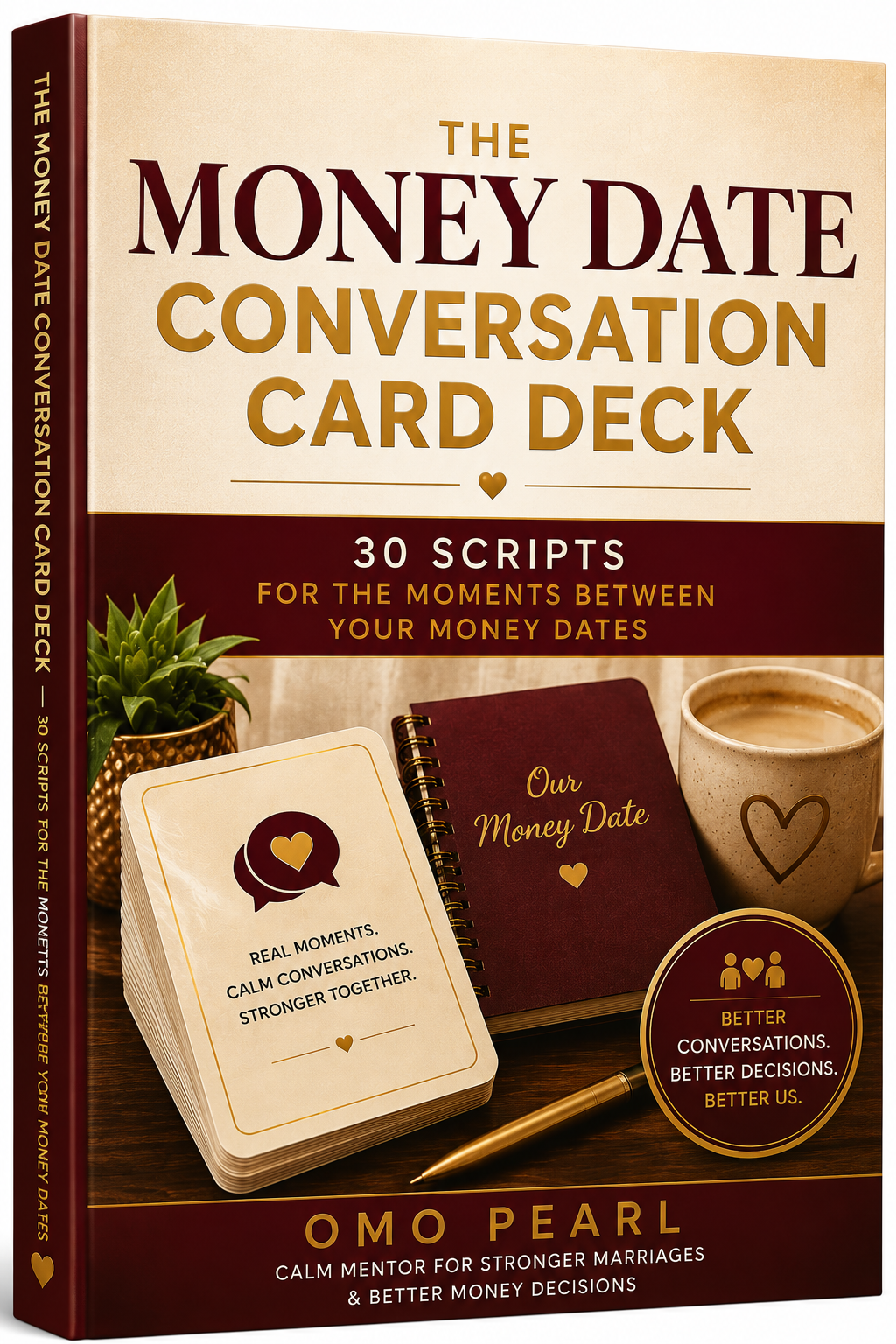
Bonus 1: The Money Date Conversation Card Deck
Value: ₦4,500 — FREE today
30 ready-to-use scripts for the moments between your scheduled Money Dates — unexpected family requests, tense purchases, and everything in between.
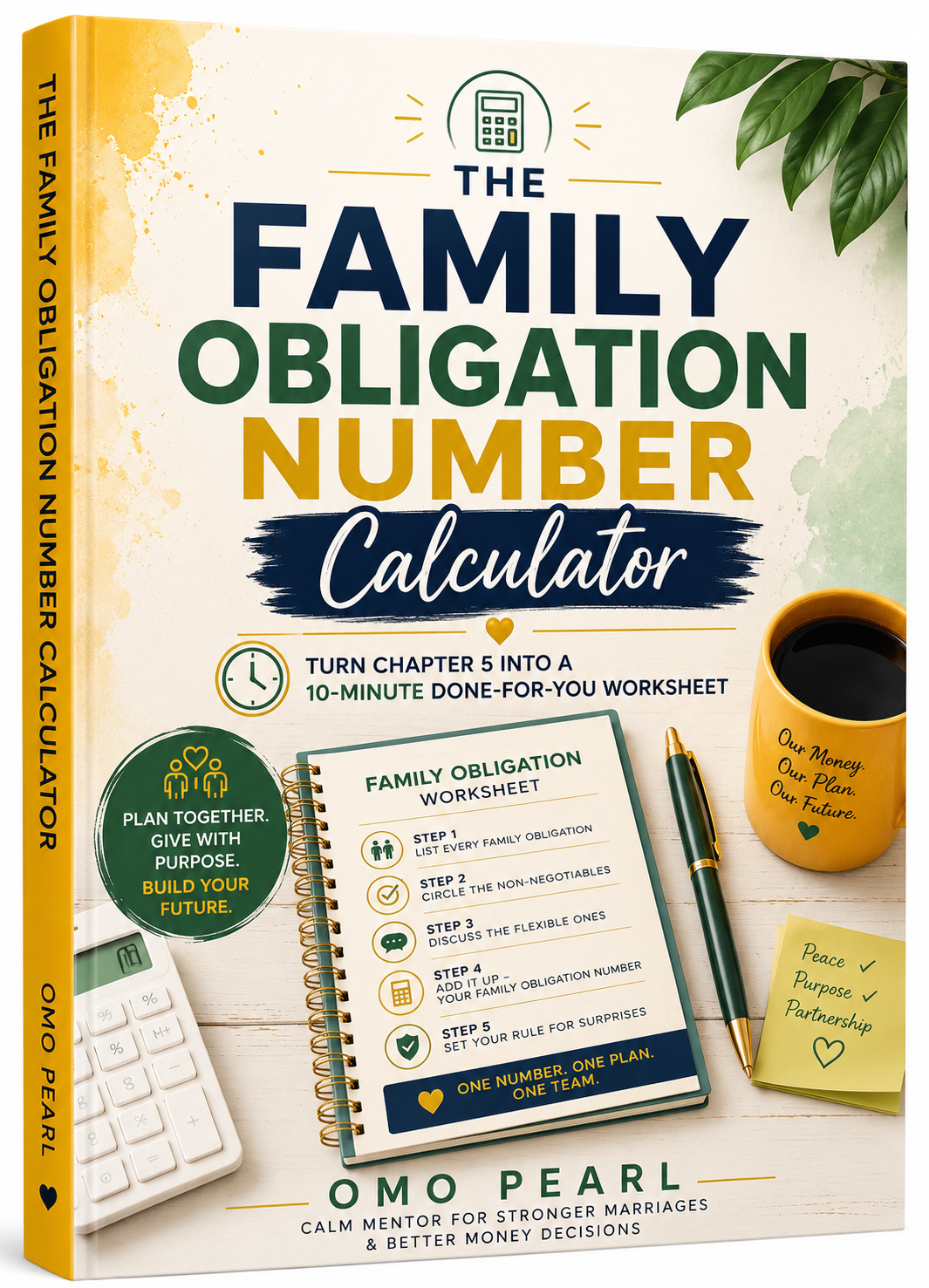
Bonus 2: The Family Obligation Number Calculator
Value: ₦3,500 — FREE today
A fillable worksheet that walks you and your spouse through agreeing on your Family Obligation Number in about 10 minutes.

Bonus 3: The 12-Month Money Date Tracker
Value: ₦3,000 — FREE today
One printable page to log every Money Date for a full year, so the habit stays alive long after you finish the guide.
Everything you're getting today

- ✓ The Money Talk — full guide ₦20,000
- ✓ Bonus 1 — Conversation Card Deck ₦4,500
- ✓ Bonus 2 — Family Obligation Calculator ₦3,500
- ✓ Bonus 3 — 12-Month Money Date Tracker ₦3,000
Right now, you have two choices
Do nothing
- Keep having the same money fight, in a new outfit, every month
- Keep guessing what "fair" looks like around family obligation
- Keep the quiet distance that's grown between you and your spouse
- Hope it resolves itself, the way it hasn't so far
- Stay stuck in the pattern you never had a name for
Get The Money Talk
- Finally have language for what you're actually arguing about
- Agree, together, on your Family Obligation Number
- Talk about money without it turning into a fight
- Build a habit that keeps you both aligned, month after month
- Start tonight — no appointment needed
30-Day Money-Back Guarantee
Work through the guide with your spouse, follow the Money Date Method for 30 days, and if you don't feel it's helped — email me for a full refund, no questions asked.
One last thing...
Picture yourself one month from today.
Will you and your spouse have had your first calm conversation about money, instead of your usual fight?
Will you finally know your Family Obligation Number — agreed on together, not guessed at?
Will you have a monthly habit that keeps you aligned, instead of drifting further apart?
Will the knot in your stomach around money finally start to loosen?
Now picture yourself one month from today if you close this page.
Everything stays the same. Same fight. Same silence. Same slow distance.
The difference between those two versions of you is a decision you make in the next sixty seconds.
I'm Ready — Get The Money TalkIf you've read this far and you're still hesitating —
I understand. But ask yourself honestly: is it the price, or is it something else? Sometimes we hesitate on the things that could actually help us, because some part of us isn't sure we deserve the help.
If you can't invest ₦9,800 in the peace of your own marriage, what message does that send about what you believe you're worth?
Stop hesitating. Choose yourselves.
Get The Money TalkP.S. — If you're still unsure, remember: you're covered by the 30-day guarantee. Try it with your spouse, and if it doesn't help, you get your money back.
P.P.S. — This price won't stay this low forever. If you're going to start, today is the easiest day to start.
P.P.P.S. — Every month you wait is another month of the same fight. You don't have to keep having it.
With warmth, for your marriage —
Omo Pearl
Frequently Asked Questions
How is the guide delivered?
Instantly to your email as a PDF, within a minute or two of your payment being confirmed.
Do we need any special tools or apps?
No. Just a pen, paper (or your phone notes), and 20 minutes a month together. Everything else is inside the guide.
What if we've been fighting about money for years — is it too late?
Not at all. The method is built to work regardless of how long the pattern has been going on. It's about creating a shared system going forward, not undoing the past.
What if my spouse is skeptical about doing this?
That's common, and completely okay. Start by reading Chapter 1 together — it's written to open the conversation gently, without pressure. Many partners come around once they see it's not an attack, it's a shared tool.
Is the money-back guarantee real?
Yes. Follow the method for 30 days, and if it hasn't helped, email for a full refund — no complicated process.
Why is this different from generic budgeting advice?
Because most budgeting advice is built for households without family obligation in the picture. This guide is built specifically around the conversation, the pattern, and the planning that couples navigating remittances and family support actually need.
© The Real Talk Corner. This guide is intended as general guidance and does not replace individual counselling or financial advice.
Share Your Experience