Marriage & Connection
How a Marriage Counsellor's 14-Day Method Is Helping Wives Turn "Roommate Marriages" Back Into Real Ones

If you've started feeling like you and your husband are two people running the same household instead of two people in love with each other — read every word on this page.
Nobody is shouting in your house.
Nobody is packing a bag. There's no side chic, no strange number calling at odd hours, no dramatic scene for the neighbours to gossip about.
On paper, everything is fine.
But you feel it every single day — the two of you talking about school fees, about NEPA, about who's picking up who, and never about anything real underneath all that.
You've tried the things everyone tells you to try. The date night you both were too tired to enjoy. The new perfume. The "we need to talk" conversation that somehow turned into an argument neither of you meant to have.
For one night, it felt like old times. Then Monday came, and you were back to three-word text messages and lying next to each other on your phones.
You haven't said this out loud to anyone — not your mother, not your sister, not your pastor's wife — because how do you explain a problem that has no drama attached to it?
Nothing is wrong, I just feel far from my husband. It sounds almost silly, said out loud.
But it isn't silly. It's one of the quietest, loneliest things a woman can carry — and one of the most common.
The real pain was never the silence itself. It was what the silence was doing — to how you saw yourself in your own marriage, to whether you still felt like his wife or just the woman who runs his house.
Marriage counsellors who work with couples in this exact season describe it as one of the hardest patterns to name — because nothing "bad" is happening, and yet everything feels far away.

My name is Omo Pearl. I'm a marriage counsellor — and also a wife and mother of four, which means everything in this guide, I lived first, long before I ever sat across from another couple in my office.
Years ago, a woman sat across from me in tears — not for the reason you'd expect. Her husband wasn't cheating. He wasn't violent. He wasn't even rude to her. She just looked at me and said, "Aunty Pearl, I don't know when my husband and I became strangers who share a bed."
That sentence stayed with me, because I had felt it too, in a season of my own marriage I don't talk about often — the season where we were surviving, paying bills, raising children, showing face at family functions, but quietly no longer together, even sitting in the same room.
Over years of counselling couples here in Nigeria and abroad — London, Houston, Toronto — I noticed the same pattern again and again. It wasn't the loud marriages, full of shouting and drama, that worried me most. It was the quiet ones. The ones everyone assumed were "fine." Those were the marriages closest to drifting apart for good, simply because nobody was paying attention to the silence.
That's what led me to build what I now call The Quiet Repair — a simple way back to each other, built not on big romantic gestures, but on small, honest, daily habits. The same kind of habits our grandmothers had, without ever needing a book to explain them.
It's Not Broken. It's Just Quiet.
A marriage doesn't usually die with one big explosion. It goes quiet first, so slowly that by the time you notice, you can't point to the day it started.
And that's the trap. If nothing "bad" is happening, who do you tell? Your mother says, "at least he's not outside." Your friends say, "marriage is like that, just manage am." Even you, trying to explain it to yourself, feel almost silly.
I want to be clear about something, because it matters: a broken marriage — one with betrayal, constant fighting, disrespect, or abuse — needs its own kind of help, a different fire entirely, and this guide is not the place for that. Please speak to a professional or someone you trust if that's what you're facing.
But the quiet is different. It's what happens in marriages that are, by most standards, doing okay. Bills are paid. Nobody is cheating. You still care about him, and he still cares about you. But somewhere between the third child and the promotion and the ageing parents, you stopped really seeing each other. You became roommates who share a surname.
A short check-in. Ask yourself, honestly:
When was the last time you two talked about something other than logistics? Do you feel invisible in your own home? When something happens in your day, is he still the first person you want to tell? Have you started keeping small things to yourself because sharing them feels like too much effort?
If two or more of those made you pause — that pause is exactly why this guide exists.
Here's why the fixes you've already tried haven't stuck: connection isn't something you switch on for one evening. It's more like a small fire. One big log thrown on cold ash won't make it roar back to life — it needs small, steady sticks, added often, to build heat that lasts.
That fancy dinner? That's the big log. It burns bright for one night, then burns out just as fast, if nothing feeds it in the ordinary days after.
What Our Grandmothers Had, Almost by Accident
Think about your grandmother's generation. Not perfect marriages — plenty had their own struggles. But many of those homes had one thing, almost without trying: presence.
Families ate together, not because anyone called it "quality time," but because that's just what you did. No phones to distract. That shared meal forced a small, daily check-in — "how was your day," "did you hear what happened at the market" — small talk that, added up over years, built a foundation of closeness that never needed a name.
An aunty or mother-in-law would notice a young wife going quiet, sometimes before the wife herself understood it. Husband and wife spent ordinary, unplanned time near each other — sitting on the veranda, walking to the market — and in that ordinary proximity, small moments of connection happened on their own.
We've traded a lot of that for convenience, privacy, and busyness. The good news: you don't need a village aunty, and you don't need to go back to a world without phones. You just need to rebuild small pieces of that presence, on purpose, in a way that fits your life today.
That's exactly what The Quiet Repair does — and it's built on something researchers who study relationships have actually documented, not old wives' tales: closeness isn't built by grand gestures. It's built by small, everyday moments where one partner reaches toward the other, and the other either turns toward them, or turns away. Add those moments up, day after day, and they either build a bridge — or a wall.
It is not that the connection disappeared. It is that it stopped being fed — one small, ordinary moment at a time.
The Quiet Repair — Three Phases, Fourteen Days
Phase One: Notice
Before any action, three days of simply noticing — tracking the small bids for connection you make toward each other, and whether they get turned toward, or missed. You cannot repair what you cannot see.
Phase Two: Small Acts
Seven days of small, private, consistent rituals — a phone-free meal, a ten-minute walk, one real question, a small touch, turning toward one of his bids on purpose. Small and repeatable beats big and dramatic, because small is what a real marriage can actually sustain.
Phase Three: Naming It
The conversation you've been avoiding — except by now, it doesn't come from hurt and accusation. It comes from a place of reconnection already underway, which changes everything about how it lands.
Then, a full 30-day Start Here plan that carries the habit forward long after Day 14 — because a fire, once lit, still needs feeding.
Comments From Women Reading This
Now available
The Quiet Repair
A proven path back to closeness for wives who feel like roommates in their own home
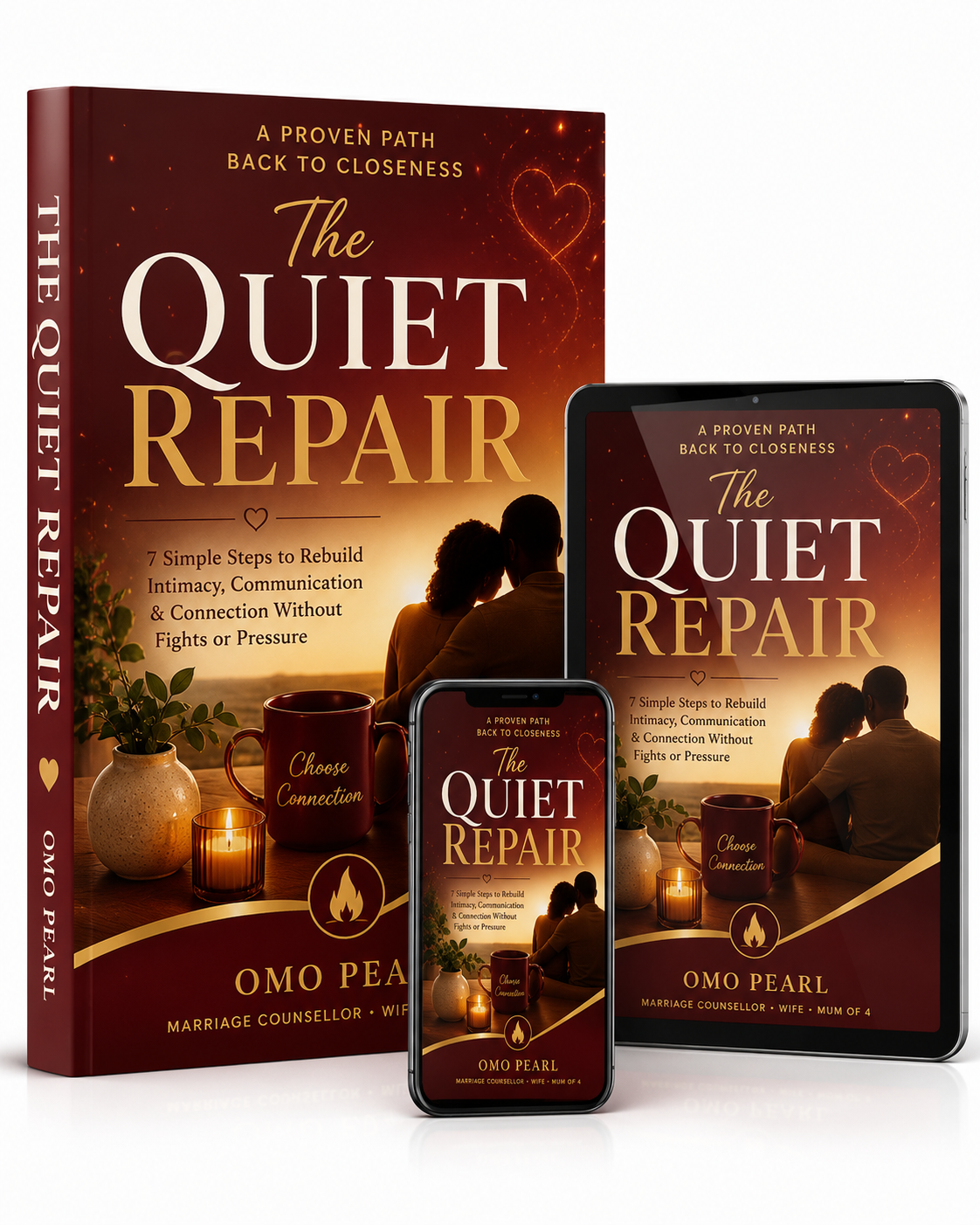
Everything inside this guide is written in plain language, so you can start tonight — no appointments, no waiting rooms, no explaining yourself to a stranger.
What's inside
- ✓ Why the quiet crept in — the real reason marriages that look "fine" quietly drift apart, and why it has nothing to do with love disappearing. (Ch. 1)
- ✓ Why date night never fixed it — the difference between a big gesture and the small, repeated habit that actually rebuilds closeness. (Ch. 2)
- ✓ The 3-day noticing exercise — a simple daily practice to see the connection you've been missing, without blame. (Ch. 4)
- ✓ The 7 small-act rituals — exact, doable daily habits that take minutes, not evenings, and fit around school runs and work. (Ch. 5)
- ✓ How to have "the conversation" without it turning into a fight — word-for-word openers that don't accuse. (Ch. 6)
- ✓ Your full 30-day Start Here plan — exactly what to do, day by day, and how to keep the habit alive after Day 14. (Ch. 7)
- ✓ What to do if he doesn't respond at first — how to tell the difference between resistance and a man who's just as quiet as you are.
How much does this guide cost?
Writing, testing this method with real couples, editing, layout, and getting it into a format you can start using tonight took real time and real cost to put together.
I'm not pricing this as a therapy session, and I'm not pricing it as a one-time splurge dinner either. I priced it so that any woman who needs it can actually afford to start tonight.
Once you click that button, here's what happens
- You're taken to a secure payment page.
- You complete payment — card, transfer, or USSD.
- Your guide is delivered to your email (and WhatsApp, if provided) within 60–90 seconds.
It's me, Omo Pearl. As long as your payment is confirmed, your access is guaranteed.
If you get The Quiet Repair today, you also get:
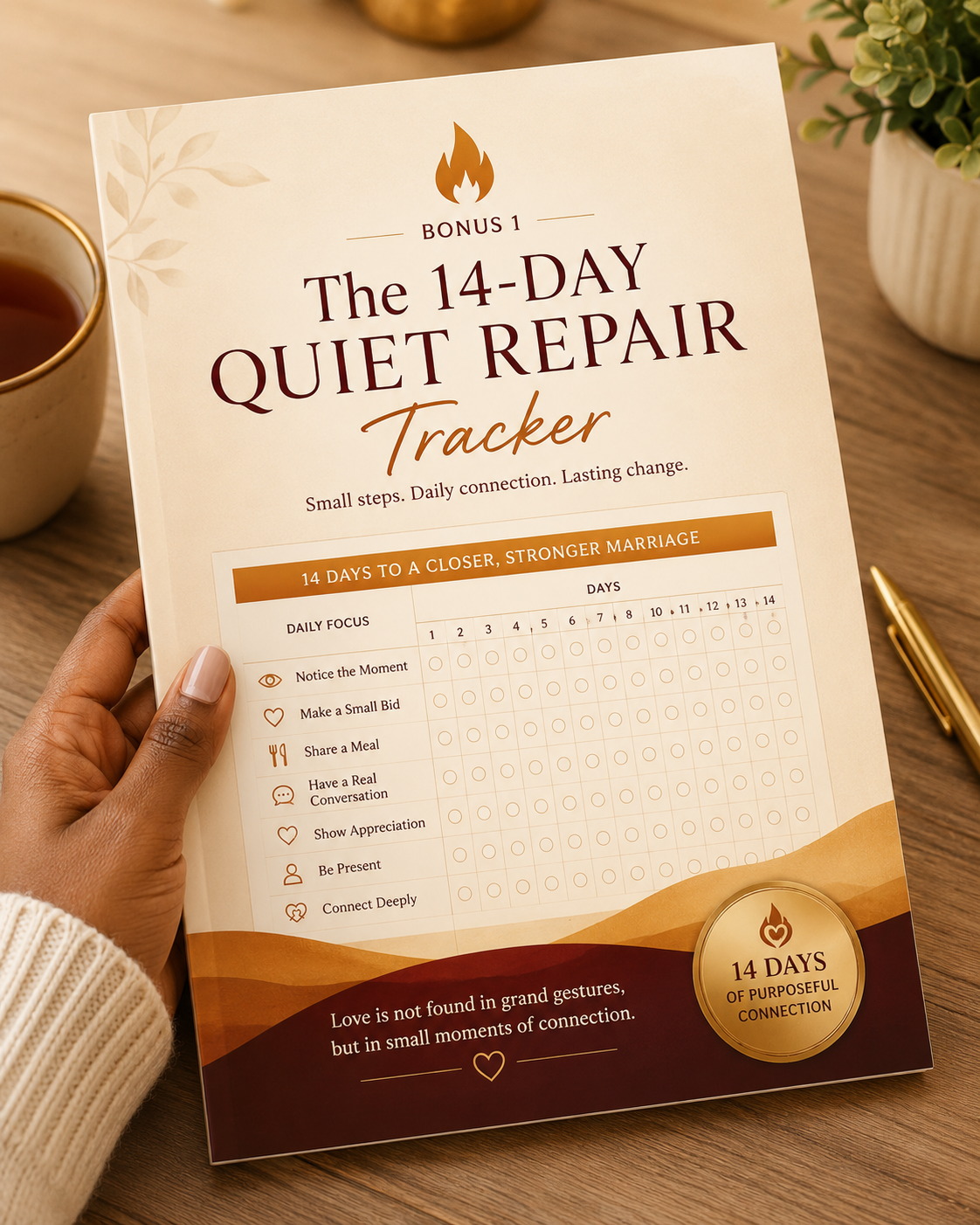
BONUS 1
The 14-Day Quiet Repair Tracker
Value: ₦1,500 — FREE today
A simple daily tracker to log the ritual you did, one bid you noticed, and whether it was turned toward or away — so you can see, in black and white, exactly how the 14 days are going before you decide on "the conversation."

BONUS 2
The Grandmother's Table
Value: ₦1,000 — FREE today
Seven simple, shareable meals — the kind our grandmothers made without needing a name for "quality time." Phones away, twenty minutes, together.
Everything you're getting today

Comments (0)
No comments yet — this section will fill in as real readers respond.
Right now, you have two choices
Close this page
- Keep having conversations about logistics and nothing else
- Keep wondering, quietly, if this is just what marriage becomes
- Keep trying date nights that don't stick past Monday
- Keep the distance you already know is there
- Come back to this page another day, maybe
Start The Quiet Repair tonight
- Begin Day 1 of noticing before you go to bed
- Have a clear, doable plan instead of guessing
- Know exactly what to say when it's time for "the conversation"
- Rebuild the small habits that quietly kept marriages warm for generations
- Stop carrying this alone
30-day guarantee
Follow the protocol for 30 days. If you don't feel it's made a difference, write in for a full refund — no long forms, no hard questions.
One last thing...
Picture yourself one month from today. Will you still be trading three-word messages across the room? Will dinner still be two people eating near each other instead of with each other? Or will there already be a small, ordinary warmth back — a longer hug, a real conversation, a walk you actually look forward to?
Now picture yourself one month from today if you close this page instead. Nothing changes. The quiet stays exactly where it is.
The difference between those two versions of you is a decision you make in the next sixty seconds.
Start The Quiet Repair tonightIf you've read this far and you're still hesitating — I understand. But ask yourself honestly what the hesitation is really about.
If you can't invest ₦7,500 in the marriage you're already living inside of every day, it's worth asking what that's really about — and whether waiting has ever once made the quiet smaller.
Stop hesitating. Choose your marriage.
P.S. — Remember, this comes with a 30-day guarantee. Try it fully before deciding whether it worked.
P.P.S. — The bonuses are included at no extra cost for now, but that's not guaranteed to stay that way.
P.P.P.S. — Every week you wait is another week of three-word conversations. You don't have to keep living in the quiet.
With love for your marriage,
Omo Pearl
Frequently asked questions
How is the guide delivered?
As a PDF, sent instantly to your email (and WhatsApp, if you provide a number) within 60–90 seconds of payment being confirmed.
Do I need any special tools or ingredients?
No. Every ritual uses things you already have — time, presence, and a phone you're willing to put down for twenty minutes.
What if we've been quiet for years, not months?
The 14-day structure still applies — it simply may take longer for both of you to feel the shift. The 30-day plan in Chapter 7 is built with that in mind.
What if my husband is skeptical?
You don't need his buy-in to start Phase One or Phase Two — noticing and small acts don't require an announcement. Chapter 6 covers what to do if he's slow to respond once you do have the conversation.
Is the guarantee real?
Yes. Follow the plan for 30 days, and if it hasn't made a difference, write in for a full refund.
Why is this different from generic "communication tips"?
Most advice jumps straight to a hard conversation. This guide builds small, low-pressure reconnection first, so that when the conversation happens, it's easier — not a confrontation.
Marriage & Connection
How a Marriage Counsellor's 14-Day Method Is Helping Wives Turn "Roommate Marriages" Back Into Real Ones
If you've started feeling like you and your husband are two people running the same household instead of two people in love with each other — read every word on this page.
Nobody is shouting in your house.
Nobody is packing a bag. There's no side chic, no strange number calling at odd hours, no dramatic scene for the neighbours to gossip about.
On paper, everything is fine.
But you feel it every single day — the two of you talking about school fees, about NEPA, about who's picking up who, and never about anything real underneath all that.
You've tried the things everyone tells you to try. The date night you both were too tired to enjoy. The new perfume. The "we need to talk" conversation that somehow turned into an argument neither of you meant to have.
For one night, it felt like old times. Then Monday came, and you were back to three-word text messages and lying next to each other on your phones.
You haven't said this out loud to anyone — not your mother, not your sister, not your pastor's wife — because how do you explain a problem that has no drama attached to it?
Nothing is wrong, I just feel far from my husband. It sounds almost silly, said out loud.
But it isn't silly. It's one of the quietest, loneliest things a woman can carry — and one of the most common.
The real pain was never the silence itself. It was what the silence was doing — to how you saw yourself in your own marriage, to whether you still felt like his wife or just the woman who runs his house.
Marriage counsellors who work with couples in this exact season describe it as one of the hardest patterns to name — because nothing "bad" is happening, and yet everything feels far away.
My name is Omo Pearl. I'm a marriage counsellor — and also a wife and mother of four, which means everything in this guide, I lived first, long before I ever sat across from another couple in my office.
Years ago, a woman sat across from me in tears — not for the reason you'd expect. Her husband wasn't cheating. He wasn't violent. He wasn't even rude to her. She just looked at me and said, "Aunty Pearl, I don't know when my husband and I became strangers who share a bed."
That sentence stayed with me, because I had felt it too, in a season of my own marriage I don't talk about often — the season where we were surviving, paying bills, raising children, showing face at family functions, but quietly no longer together, even sitting in the same room.
Over years of counselling couples here in Nigeria and abroad — London, Houston, Toronto — I noticed the same pattern again and again. It wasn't the loud marriages, full of shouting and drama, that worried me most. It was the quiet ones. The ones everyone assumed were "fine." Those were the marriages closest to drifting apart for good, simply because nobody was paying attention to the silence.
That's what led me to build what I now call The Quiet Repair — a simple way back to each other, built not on big romantic gestures, but on small, honest, daily habits. The same kind of habits our grandmothers had, without ever needing a book to explain them.
It's Not Broken. It's Just Quiet.
A marriage doesn't usually die with one big explosion. It goes quiet first, so slowly that by the time you notice, you can't point to the day it started.
And that's the trap. If nothing "bad" is happening, who do you tell? Your mother says, "at least he's not outside." Your friends say, "marriage is like that, just manage am." Even you, trying to explain it to yourself, feel almost silly.
I want to be clear about something, because it matters: a broken marriage — one with betrayal, constant fighting, disrespect, or abuse — needs its own kind of help, a different fire entirely, and this guide is not the place for that. Please speak to a professional or someone you trust if that's what you're facing.
But the quiet is different. It's what happens in marriages that are, by most standards, doing okay. Bills are paid. Nobody is cheating. You still care about him, and he still cares about you. But somewhere between the third child and the promotion and the ageing parents, you stopped really seeing each other. You became roommates who share a surname.
A short check-in. Ask yourself, honestly:
When was the last time you two talked about something other than logistics? Do you feel invisible in your own home? When something happens in your day, is he still the first person you want to tell? Have you started keeping small things to yourself because sharing them feels like too much effort?
If two or more of those made you pause — that pause is exactly why this guide exists.
Here's why the fixes you've already tried haven't stuck: connection isn't something you switch on for one evening. It's more like a small fire. One big log thrown on cold ash won't make it roar back to life — it needs small, steady sticks, added often, to build heat that lasts.
That fancy dinner? That's the big log. It burns bright for one night, then burns out just as fast, if nothing feeds it in the ordinary days after.
What Our Grandmothers Had, Almost by Accident
Think about your grandmother's generation. Not perfect marriages — plenty had their own struggles. But many of those homes had one thing, almost without trying: presence.
Families ate together, not because anyone called it "quality time," but because that's just what you did. No phones to distract. That shared meal forced a small, daily check-in — "how was your day," "did you hear what happened at the market" — small talk that, added up over years, built a foundation of closeness that never needed a name.
An aunty or mother-in-law would notice a young wife going quiet, sometimes before the wife herself understood it. Husband and wife spent ordinary, unplanned time near each other — sitting on the veranda, walking to the market — and in that ordinary proximity, small moments of connection happened on their own.
We've traded a lot of that for convenience, privacy, and busyness. The good news: you don't need a village aunty, and you don't need to go back to a world without phones. You just need to rebuild small pieces of that presence, on purpose, in a way that fits your life today.
That's exactly what The Quiet Repair does — and it's built on something researchers who study relationships have actually documented, not old wives' tales: closeness isn't built by grand gestures. It's built by small, everyday moments where one partner reaches toward the other, and the other either turns toward them, or turns away. Add those moments up, day after day, and they either build a bridge — or a wall.
It is not that the connection disappeared. It is that it stopped being fed — one small, ordinary moment at a time.
The Quiet Repair — Three Phases, Fourteen Days
Phase One: Notice
Before any action, three days of simply noticing — tracking the small bids for connection you make toward each other, and whether they get turned toward, or missed. You cannot repair what you cannot see.
Phase Two: Small Acts
Seven days of small, private, consistent rituals — a phone-free meal, a ten-minute walk, one real question, a small touch, turning toward one of his bids on purpose. Small and repeatable beats big and dramatic, because small is what a real marriage can actually sustain.
Phase Three: Naming It
The conversation you've been avoiding — except by now, it doesn't come from hurt and accusation. It comes from a place of reconnection already underway, which changes everything about how it lands.
Then, a full 30-day Start Here plan that carries the habit forward long after Day 14 — because a fire, once lit, still needs feeding.
Comments From Women Reading This
Now available
The Quiet Repair
A proven path back to closeness for wives who feel like roommates in their own home
Everything inside this guide is written in plain language, so you can start tonight — no appointments, no waiting rooms, no explaining yourself to a stranger.
What's inside
- ✓ Why the quiet crept in — the real reason marriages that look "fine" quietly drift apart, and why it has nothing to do with love disappearing. (Ch. 1)
- ✓ Why date night never fixed it — the difference between a big gesture and the small, repeated habit that actually rebuilds closeness. (Ch. 2)
- ✓ The 3-day noticing exercise — a simple daily practice to see the connection you've been missing, without blame. (Ch. 4)
- ✓ The 7 small-act rituals — exact, doable daily habits that take minutes, not evenings, and fit around school runs and work. (Ch. 5)
- ✓ How to have "the conversation" without it turning into a fight — word-for-word openers that don't accuse. (Ch. 6)
- ✓ Your full 30-day Start Here plan — exactly what to do, day by day, and how to keep the habit alive after Day 14. (Ch. 7)
- ✓ What to do if he doesn't respond at first — how to tell the difference between resistance and a man who's just as quiet as you are.
How much does this guide cost?
Writing, testing this method with real couples, editing, layout, and getting it into a format you can start using tonight took real time and real cost to put together.
I'm not pricing this as a therapy session, and I'm not pricing it as a one-time splurge dinner either. I priced it so that any woman who needs it can actually afford to start tonight.
Once you click that button, here's what happens
- You're taken to a secure payment page.
- You complete payment — card, transfer, or USSD.
- Your guide is delivered to your email (and WhatsApp, if provided) within 60–90 seconds.
It's me, Omo Pearl. As long as your payment is confirmed, your access is guaranteed.
If you get The Quiet Repair today, you also get:
BONUS 1
The 14-Day Quiet Repair Tracker
Value: ₦1,500 — FREE today
A simple daily tracker to log the ritual you did, one bid you noticed, and whether it was turned toward or away — so you can see, in black and white, exactly how the 14 days are going before you decide on "the conversation."
BONUS 2
The Grandmother's Table
Value: ₦1,000 — FREE today
Seven simple, shareable meals — the kind our grandmothers made without needing a name for "quality time." Phones away, twenty minutes, together.
Everything you're getting today
Comments (0)
No comments yet — this section will fill in as real readers respond.
Right now, you have two choices
Close this page
- Keep having conversations about logistics and nothing else
- Keep wondering, quietly, if this is just what marriage becomes
- Keep trying date nights that don't stick past Monday
- Keep the distance you already know is there
- Come back to this page another day, maybe
Start The Quiet Repair tonight
- Begin Day 1 of noticing before you go to bed
- Have a clear, doable plan instead of guessing
- Know exactly what to say when it's time for "the conversation"
- Rebuild the small habits that quietly kept marriages warm for generations
- Stop carrying this alone
30-day guarantee
Follow the protocol for 30 days. If you don't feel it's made a difference, write in for a full refund — no long forms, no hard questions.
One last thing...
Picture yourself one month from today. Will you still be trading three-word messages across the room? Will dinner still be two people eating near each other instead of with each other? Or will there already be a small, ordinary warmth back — a longer hug, a real conversation, a walk you actually look forward to?
Now picture yourself one month from today if you close this page instead. Nothing changes. The quiet stays exactly where it is.
The difference between those two versions of you is a decision you make in the next sixty seconds.
Start The Quiet Repair tonightIf you've read this far and you're still hesitating — I understand. But ask yourself honestly what the hesitation is really about.
If you can't invest ₦7,500 in the marriage you're already living inside of every day, it's worth asking what that's really about — and whether waiting has ever once made the quiet smaller.
Stop hesitating. Choose your marriage.
P.S. — Remember, this comes with a 30-day guarantee. Try it fully before deciding whether it worked.
P.P.S. — The bonuses are included at no extra cost for now, but that's not guaranteed to stay that way.
P.P.P.S. — Every week you wait is another week of three-word conversations. You don't have to keep living in the quiet.
With love for your marriage,
Omo Pearl
Frequently asked questions
How is the guide delivered?
As a PDF, sent instantly to your email (and WhatsApp, if you provide a number) within 60–90 seconds of payment being confirmed.
Do I need any special tools or ingredients?
No. Every ritual uses things you already have — time, presence, and a phone you're willing to put down for twenty minutes.
What if we've been quiet for years, not months?
The 14-day structure still applies — it simply may take longer for both of you to feel the shift. The 30-day plan in Chapter 7 is built with that in mind.
What if my husband is skeptical?
You don't need his buy-in to start Phase One or Phase Two — noticing and small acts don't require an announcement. Chapter 6 covers what to do if he's slow to respond once you do have the conversation.
Is the guarantee real?
Yes. Follow the plan for 30 days, and if it hasn't made a difference, write in for a full refund.
Why is this different from generic "communication tips"?
Most advice jumps straight to a hard conversation. This guide builds small, low-pressure reconnection first, so that when the conversation happens, it's easier — not a confrontation.